
From 10 to 12 March 2026, SSUCHY-Next will present its latest bio-based composite innovations at JEC World 2026 (Hall 5 – Stand 5B74, Bio-Materials Village).
At the heart of the booth: industrial semi-products, advanced textile reinforcements, laboratory-validated material specimens, durability assessments and full-scale structural demonstrators. Together, they illustrate how hemp fibres and innovative bio-based resins are progressing from material optimisation and performance validation to high-performance structural applications.
These demonstrators reflect the project’s multi-scale ambition: scaling up hemp fibre production, validating material durability and compatibility, and integrating bio-based composites into demanding industrial sectors such as wind energy and construction.
From fibre to semi-product: scalable hemp reinforcements
HempTape – Eco-Technilin
Scalable unidirectional hemp tape for composite manufacturing
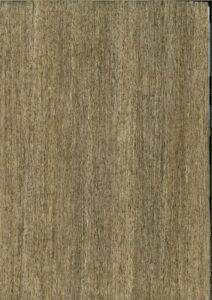 HempTape is an innovative unidirectional reinforcing material made of long hemp fibers aligned in the longitudinal direction and consolidated using a process patented by Eco-Technilin.
Developed as part of the SSUCHY-Next project, HempTape was initially produced at pilot scale and will be scaled up to industrial production by Eco-Technilin in 2026.
The controlled alignment of the hemp fibers allows full exploitation of their intrinsic mechanical properties.
This architecture enhances load transfer in composite materials and supports the development of higher-performance bio-based composites.
HempTape is a versatile intermediate material (semi-finished product), compatible with a wide range of composite manufacturing processes, such as vacuum infusion or RTM.
To date, several tens of kilograms of HempTape have been produced, serving as a demonstrator for both material and process, and contributing to optimization and scale-up activities.
Quasi-unidirectional hemp fabrics – Linificio
Advanced textile reinforcements for structural composites
 The quasi-unidirectional hemp fabrics are textile demonstrators developed within the SSUCHY-Next project to showcase advanced bio-based reinforcements for composite materials. By concentrating fibres predominantly in one direction, these fabrics address the mechanical limitations of conventional woven or randomly oriented natural fibre textiles, enabling more efficient load transfer and improved structural performance potential. The fabrics demonstrate the compatibility of hemp fibres with industrial textile processing routes and their suitability for composite manufacturing. Produced at pilot scale, they serve as intermediate demonstrators supporting material validation, composite testing and further optimisation toward scalable, low-impact composite solutions.
Material validation & performance assessment
Hygrothermal durability & long-term performance – TU Delft
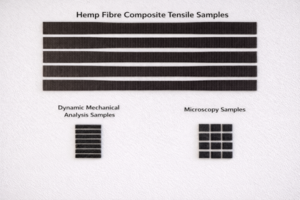 At Delft University of Technology, the hygrothermal durability of thermoplastic and thermoset hemp fibre composites is systematically evaluated.
Monotonic tensile tests determine mechanical properties, while fatigue and creep testing assess long-term durability and time-dependent behaviour under cyclic and sustained loading.
Dynamic mechanical analysis (DMA) characterises viscoelastic properties and temperature- or frequency-dependent behaviour. Microscopy investigations
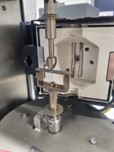
complement mechanical testing by examining specimen quality and identifying damage mechanisms.
Together, these analyses provide a comprehensive understanding of material performance under mechanical loading and environmental exposure, a key step toward structural reliability in real-life applications.
Resin–fibre compatibility demonstrator – KU Leuven
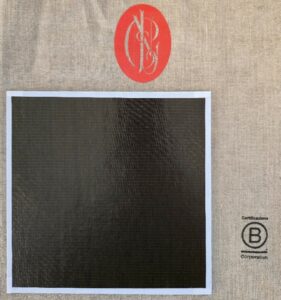 At KU Leuven, researchers characterise fibre preforms and newly developed bio-based resin systems to provide targeted feedback to all project partners.
Fibres and resins are evaluated for mechanical performance and mutual compatibility, and required improvements are investigated in close collaboration with industry.
At the SSUCHY-Next booth, visitors will discover a demonstrator specimen manufactured in KU Leuven laboratories using:
- Linificio’s quasi-UD hemp preform
- Arkema’s infusion-grade Elium® resin
This specimen showcases the excellent compatibility of both materials in vacuum infusion processes and illustrates how optimised material combinations contribute to scalable, high-performance bio-based composites.
Wind energy demonstrator
Bio-based blade prototype – Université Marie et Louis Pasteur
A multi-scale demonstrator for wind turbine applications
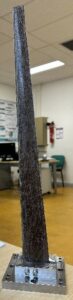 This blade prototype, manufactured from a bio-based composite, is part of a multi-scale investigation aimed at bridging the gap between damping behaviour at composite material scale structural scale (wind turbine blade). Following the identification and understanding of damping and stiffness mechanisms at the material level, this intermediate demonstrator enables the introduction of realistic structural effects, including geometry, assembly, boundary conditions, and aerodynamic effects. It therefore represents a key step in assessing whether the trends observed at the composite scale are preserved at the blade scale, where the global dynamic response is governed by the combined influence of material properties and structural effects.
Construction sector demonstrator
Nabasco Façade Panel – NPSP
Circular, bio-based load-bearing façade element
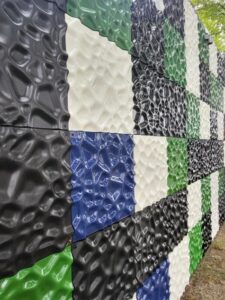 Facades are more than just an important design tool; they also offer excellent opportunities to further enhance the sustainability of a building and reduce the negative impact of the construction sector on the climate. For example, by designing facade elements circularly and making them from local organic (waste) materials. Within the Ssuchy_Next project we are working on enhancing mechanical properties, developing mechanical recycling, developing a model to control the quality, use new recycleable resins, hemp fibers. This is a proototype of a highly biobased and waste based façade panel, with a long-term storage of 20kg of CO2 per square meter of facade surface.
📍 Meet the consortium at JEC World 2026 – Hall 5, Stand 5B74
Discover how hemp-based composites are shaping the next generation of sustainable structural materials!

No comment yet, add your voice below!