
Composite materials are all around us, from cars and building panels to boats and sports equipment. Their principle is simple: combining materials with different properties can create a new material that performs better than either component alone.
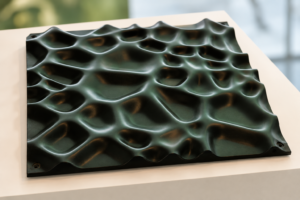
A fibre-reinforced composite contains two main elements: reinforcing fibres and a polymer matrix. The resin is the material used to surround the fibres and once hardened, forms this matrix. In a biocomposite, at least one component comes from a renewable source. When both the fibres and the matrix are bio-based, we move towards a fully bio-based composite.
What does the matrix actually do ?
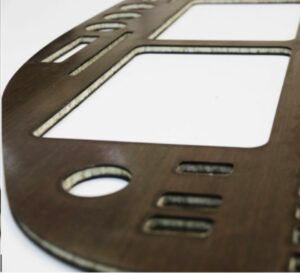
Fibres such as hemp, flax, glass or carbon can be extremely strong along their length but on their own they cannot maintain the shape of a panel or vehicle part. The matrix brings them together so that they behave as one material.
Its main functions are to:
- bind the fibres and keep them in the correct position
- transfer loads from one fibre to another
- give the part its final shape and surface
- protect the fibres from impacts, wear and environmental exposure
- slow down the propagation of cracks
The interface between the fibres and the matrix is therefore crucial. If the resin does not properly penetrate and adhere to the fibres, loads cannot be transferred efficiently, reducing the strength and durability of the composite.
Resins generally fall into two families:
- Thermosets (TS), such as conventional epoxies and benzoxazines, form a permanent network when cured. They provide good mechanical, thermal and chemical resistance but are usually difficult to reshape.
- Thermoplastics (TP) can soften when heated, making them potentially easier to reshape or recycle, although they can be more difficult to introduce between the fibres.
One material principle, many applications
There is no single ideal matrix for every composite. Its properties must be adapted to the conditions in which the final product will be manufactured and used.
For example:
- construction panels need to resist moisture, weathering and fire
- vehicle components must be lightweight, durable and impact-resistant
- boats require good resistance to water and harsh outdoor conditions
- sports equipment must combine low weight, stiffness and resistance to repeated loads
- wind turbine blades must withstand changing weather and millions of loading cycles.
The choice of matrix also determines which manufacturing methods can be used. A low-viscosity liquid resin can flow through a large fibre structure inside a mould, while other matrices are better suited to pressing, injection or flexible products. Research on architectural biocomposites has shown that combining natural fibres with rigid, flexible or thermoset matrices can produce objects ranging from curved façade panels to flooring and furniture elements.
This choice also affects environmental performance and end-of-life options. For example, replacing glass fibres with flax in polypropylene composites could create components that were 6% lighter, with environmental impacts reduced by 10-[1] However, using natural fibres does not automatically make a composite sustainable: the origin of the resin, manufacturing process, durability and recyclability must all be considered.
How is the matrix used in SSUCHY-Next?
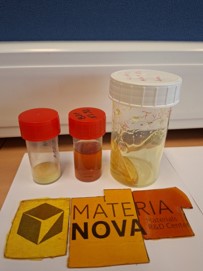
SSUCHY-Next applies this same principle by matching hemp reinforcements with both enhanced TP and advanced TS bio-based resin systems designed for different products:
- A bio-based acrylic polymer Elium® (Arkema), processed as a TS liquid -to ease reinforcement impregnation- before becoming a thermoplastic, with a targeted bio-based content of up to 95%. Its fluidity makes it suitable for vacuum infusion and for penetrating wood structures.
- Fully bio-based vitrimeric benzoxazines (Materia Nova and Bitrez), designed as alternative or complement to epoxy TS resins to provide at the same time mechanical performance, thermal stability, charring ability, low moisture uptake and reprocessability to facilitate recycling thanks to the integration of dynamic exchangeable bonds.
These matrices allow the project to explore several applications. The acrylic resin is used for a 12.6 metre hemp-fibre wind turbine blade, and laminated wood products for construction. Benzoxazine is combined with shorter hemp fibres to manufacture façade elements, traffic signs and electrical enclosures. It is also paired with unidirectional (UD) hemp reinforcements to manufacture prepregs or hybrid stacks for the construction, building, and urban furniture sectors.
For each application, the matrix must hold the reinforcement together, transfer loads, protect it and provide the properties required by its intended use. SSUCHY-Next therefore studies fibre-matrix adhesion, moisture durability, mechanical performance, fire behaviour and recycling, while using life-cycle assessment to guide material choices.
The matrix may be less visible than the fibres, but it is what allows them to work together. Rethinking this essential component is central to SSUCHY-Next’s ambition to develop high-performance hemp-based composites using more renewable resources and offering more realistic end-of-life pathways.
Sources
Bioeconomy For Change, SSUCHY-Next Market Analysis, Deliverable 8.8 (confidential) , draft 2026
SSUCHY-Next Grant Agreement – Part B (confidential)
H. Dahy, “Biocomposite materials based on annual natural fibres and biopolymers”, Construction and Building Materials, 147, 2017
H. Ahmad et al., “A Comprehensive Review on Construction Applications and Life Cycle Sustainability of Natural Fiber Biocomposites”, Sustainability, 14, 2022, 15905




No comment yet, add your voice below!