
As wind energy expands across Europe, researchers are exploring how new materials could make wind turbine blades more sustainable, circular and resilient. From natural fibres to innovative manufacturing processes, the challenge is to reduce their environmental impact while maintaining the mechanical performance required for demanding structural applications.
Why look for new materials for wind turbine blades?
Wind turbine blades are designed to operate for 25 years while being exposed to changing winds, repeated mechanical loads and demanding environmental conditions. Their materials, therefore, need to combine low weight with high stiffness, strength, and durability.
Today, blades mainly rely on composite materials reinforced with glass or carbon fibres. These materials offer excellent mechanical performance, but their end-of-life management remains challenging, particularly because fibres and polymers are strongly bonded together and difficult to separate and recycle.
This challenge is becoming increasingly important as more wind turbines reach the end of their service life. Although around 90-95% of a wind turbine’s mass is considered recyclable, composite blades remain one of the main obstacles to improving circularity in the sector.
Researchers are therefore exploring alternative materials and new composite designs that could maintain the performance required for wind energy while reducing dependence on conventional materials and improving their environmental profile.
Among these alternatives, natural fibres such as flax and hemp are attracting growing interest because they are renewable, lightweight and could potentially reduce the environmental footprint of composite structures.²
However, replacing conventional fibres is not as simple as swapping one material for another. Natural-fibre composites still need to demonstrate sufficient mechanical strength, durability, consistency and scalability for demanding structural applications such as wind turbine blades.
This is where SSUCHY-Next comes in. By developing high-performance bio-based composites based on hemp fibres, the project aims to explore how renewable materials could meet the demanding requirements of structural applications, including wind turbine blades.
Did you know?
Wind turbines may already be largely recyclable by mass, but their blades remain particularly challenging. According to projections reported by the European Commission’s Joint Research Centre (JRC), wind turbine blade waste in Europe could increase substantially in the coming decades, highlighting the need for more circular material solutions.
SSUCHY-Next: from hemp fibres to wind turbine blades
SSUCHY-Next aims to demonstrate the potential of high-performance, circular-by-design bio-based composites for large structural applications.
For the wind energy sector, the project has set a concrete objective: to manufacture and test a 12.6-metre wind turbine blade using bio-based composite materials.
Achieving this objective requires more than developing a new material. It involves working across the entire value chain, from hemp fibre production and textile reinforcement development to bio-based matrices, structural modelling and manufacturing optimisation.
Building performance from the fibre up
The first challenge is to produce hemp fibres with sufficiently high and consistent mechanical properties for load-bearing composites.
Unlike synthetic fibres, natural fibres can exhibit significant variability depending on growing conditions, harvesting methods and processing techniques. They may also contain structural defects that affect their mechanical performance.
SSUCHY-Next is therefore working on hemp cultivation, harvesting, retting and fibre extraction while investigating how to minimise defects and improve fibre quality and consistency.
The fibres are then transformed into textile reinforcements suitable for composite manufacturing, including yarns, woven fabrics and quasi-unidirectional materials, in which most fibres are aligned in one direction to provide strength and stiffness where they are most needed.
These developments are essential for producing composite materials that meet the requirements of large structural components.
Developing the right bio-based matrices
The reinforcement is only one-half of a composite. The other is the matrix, the material that binds the fibres together, transfers mechanical loads between them and helps protect them from environmental conditions.
SSUCHY-Next is developing several bio-based and circular matrix solutions, including fully bio-based thermoset systems and a new grade of the recyclable thermoplastic resin Elium® with increased bio-based content.
These different systems are being investigated to identify suitable combinations of fibres, matrices and manufacturing processes for the project’s applications.
Beyond developing the materials themselves, researchers are studying how hemp fibres and matrices interact once combined. This includes improving fibre/matrix compatibility and evaluating mechanical properties and durability, particularly when composites are exposed to moisture.
Understanding these interactions is essential to ensure that the resulting materials can maintain their performance under demanding operating conditions.
Understanding how hemp composites behave
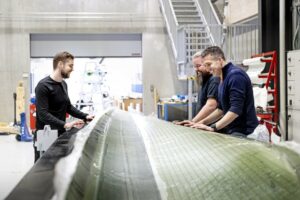 Developing a new material is not enough. Engineers also need to understand how it behaves under different loading conditions before using it in structural components.
Plant-fibre composites do not behave exactly like conventional glass- or carbon-fibre composites, particularly when subjected to complex and repeated mechanical loads.
SSUCHY-Next is therefore developing numerical models to better understand and predict these specific behaviours, helping engineers integrate the properties of hemp-based composites into structural design.
The project is also investigating one particularly interesting property of plant-fibre composites: their ability to damp vibrations.
Previous research has shown that certain plant-fibre composites can exhibit higher vibration damping than conventional glass- or carbon-fibre composites, making them particularly interesting for structures exposed to dynamic loads.
For wind turbine blades, which experience continuous vibrations and fluctuating mechanical forces during operation, this property could offer interesting opportunities.
SSUCHY-Next is investigating how to combine this damping potential with the high stiffness and mechanical performance required for structural applications.
Rethinking the manufacturing process
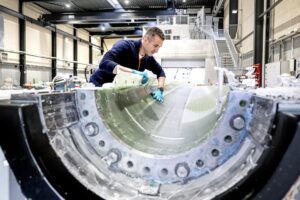 Changing the material also means reconsidering how the final composite structure is manufactured.
Wind turbine blades are commonly produced using vacuum infusion, a process in which liquid resin is drawn through layers of reinforcing fibres under vacuum before hardening into a solid composite structure.
Introducing new hemp-based reinforcements and resin systems requires a better understanding of how these materials behave during manufacturing, particularly how the resin flows through the fibre structure.
SSUCHY-Next will characterise its new material systems and use numerical simulations to better understand and optimise the infusion process.
The objective is not only to manufacture the blade successfully, but also to explore opportunities to reduce material and energy consumption, shorten production cycle times and improve manufacturing consistency.
In other words, SSUCHY-Next is not simply asking whether glass fibre can be replaced by hemp. It is rethinking the material, the way engineers design with it and the way the blade is manufactured.
Putting the materials to the test: a 12.6-metre blade
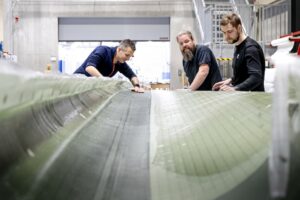 All these developments ultimately converge in the project’s wind turbine blade demonstrator.
Moving from laboratory samples to a 12.6-metre structure represents an important step towards demonstrating the potential of hemp-based composites in industrially relevant applications.
A material that performs well in a laboratory test still needs to demonstrate that it can be processed reliably and deliver the required structural properties when used in a much larger and more complex component.
The demonstrator will therefore provide an opportunity to evaluate the materials and manufacturing approaches developed throughout SSUCHY-Next at a representative scale.
Comparisons with a conventional glass-fibre/epoxy reference blade will focus on structural response, manufacturing processes, material and energy consumption, and production cycle times.
These evaluations will help identify both the potential benefits and the remaining technical challenges associated with the use of hemp-based composites in large structural applications.
Towards more sustainable wind turbine blades
Developing more sustainable wind turbine blades is not simply about replacing conventional materials with renewable alternatives. It requires rethinking the entire process, from fibre production and composite design to manufacturing and structural performance.
Natural fibres also come with their own technical challenges, including variability, moisture sensitivity and the need to demonstrate long-term durability. This is precisely why research, testing and demonstration at scale are essential.
Through its 12.6-metre wind turbine blade demonstrator, SSUCHY-Next aims to show how hemp-based composites could contribute to this transition while addressing the technical challenges associated with their use in demanding structural applications.
By bringing together material innovation, advanced modelling and industrially relevant manufacturing, the project is helping to explore new pathways towards more sustainable wind energy technologies.
Bibliography
European Commission, Joint Research Centre (JRC). (2025). Deep dive on critical raw materials for wind turbines in the EU. Publications Office of the European Union.
Amzil, L., Fertahi, S., Raffak, T., & Mouhib, T. (2025). Towards sustainable blade design: A critical review of natural fiber-reinforced hybrid composites and structural analysis tutorials. Next Materials, 8, 100688. https://doi.org/10.1016/j.nxmate.2025.100688 1-s2.0-S2949822825002060-main
SSUCHY-Next – Grant Agreement No. 101157517, Description of Action – Part B. Horizon Europe, Circular Bio-based Europe Joint Undertaking.



No comment yet, add your voice below!